
By Glend MaatitaUpdated
What is DevOps?
DevOps is a set of practices that unites software development (Dev) and IT operations (Ops) so teams can build, test, release, and run software faster and more reliably. This guide explains what it means, how the DevOps lifecycle works, and the principles, tools, and benefits behind it.
DevOps is a way of working that combines software development (Dev) and IT operations (Ops) into one continuous delivery process. Instead of developers writing code and a separate team running it in production, both share responsibility for a change from the first commit all the way to release.
The result is faster, safer, and more frequent releases: shipping software stops being a risky, once-a-quarter event and becomes a routine, automated one. Below, we explain what DevOps means, how the DevOps lifecycle works, the principles and tools behind it, and how it compares to related approaches like Agile and SRE.
What does DevOps mean?
The word DevOps combines “development” and “operations.” It describes a culture and a set of practices that break down the wall between the people who build software and the people who keep it running in production.
Traditionally, developers were measured on shipping change while operations teams were measured on keeping systems stable, two goals that pull in opposite directions. DevOps aligns them around one shared outcome: delivering reliable software quickly. Fewer handoffs mean fewer misunderstandings, faster releases, and quicker recovery when something breaks.
How does DevOps work? The DevOps lifecycle
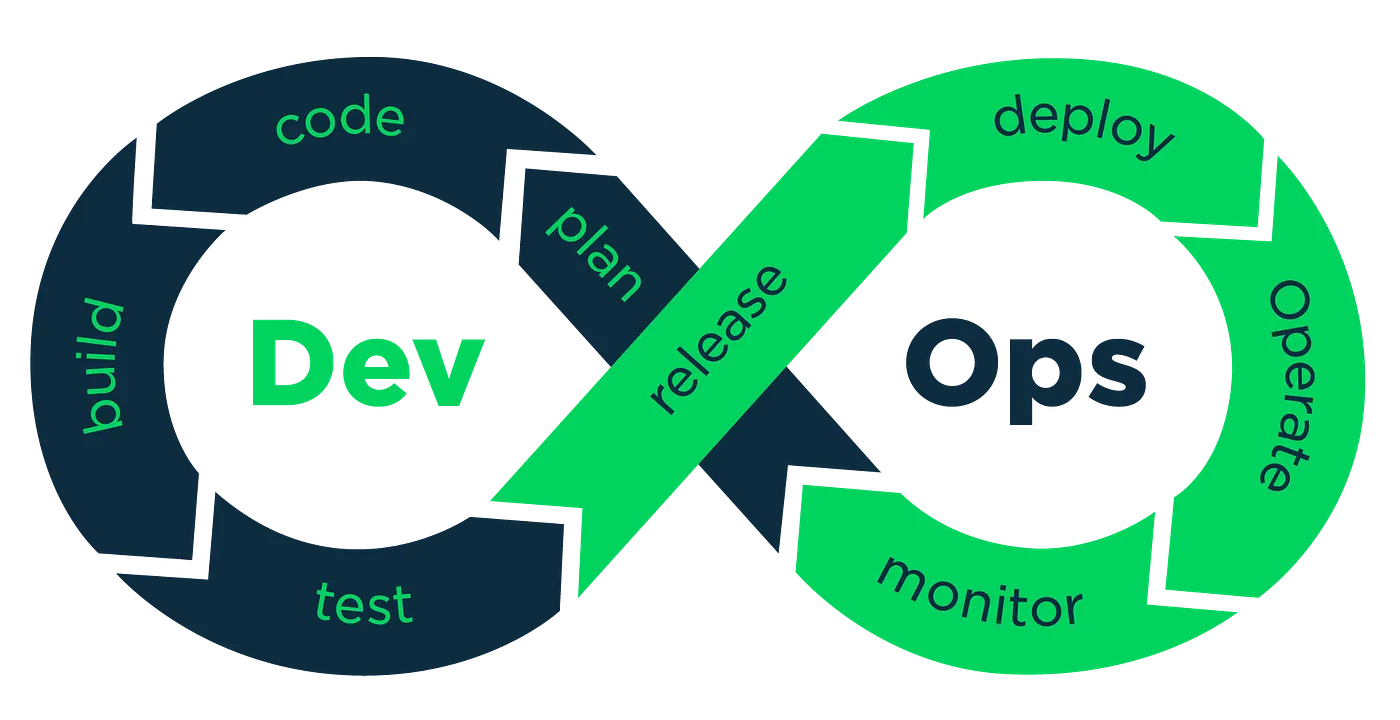
DevOps organizes work as a continuous loop rather than a one-way pipeline. Each stage feeds the next, and feedback from production flows straight back into planning, which is why the DevOps lifecycle is usually drawn as an infinity symbol. A typical lifecycle runs through eight continuous stages:
- Plan: define features, requirements, and the work to be done.
- Code: write and review application and infrastructure code in version control.
- Build: compile and package the code into a deployable artifact.
- Test: run automated tests to catch bugs before release.
- Release: promote a validated build toward production.
- Deploy: ship the change to production, ideally through an automated pipeline.
- Operate: run the software reliably at scale.
- Monitor: observe behaviour in production and feed insights back into planning.
Three practices make this loop possible. Continuous integration and continuous delivery (CI/CD) automate build, test, and release; infrastructure as code (IaC) defines environments in version-controlled files; and observability lets you see how the system behaves in real time.
The core principles of DevOps
Tools change constantly, so strong DevOps is built on principles rather than any single product. At 8grams, we hold every environment we build to three of them.
Automation
Automation is the engine of DevOps. Provisioning, testing, deployment, and monitoring run without a human in the loop, which removes manual error and lets teams release on demand. A useful rule of thumb is that if a task is done more than twice, it gets scripted.
Auditability
Every change should be traceable and trackable. Code and infrastructure live in version control, logs are centralized, and metrics and alerts show who changed what, when, and what happened next. That record is the foundation for both fast debugging and passing compliance audits.
Vendor-agnosticism (no lock-in)
Choosing tools and architectures that aren't tied to a single provider keeps you free to pick the best fit for each need and to move between AWS, Google Cloud, or your own servers later. Where a solid open-source or self-hosted option exists, it is often preferred over a proprietary managed service.
Key DevOps tools and technologies
DevOps teams combine tools across the build, ship, and run lifecycle, and most of them fall into a handful of categories. The most common examples are:
- Containers: Docker for packaging applications and Kubernetes for orchestrating them at scale.
- Infrastructure as code: Terraform for provisioning and Ansible for configuration management.
- CI/CD: Jenkins, GitLab CI/CD, GitHub Actions, or Tekton to automate build, test, and deployment.
- Monitoring and logging: Prometheus and Grafana for metrics, the ELK Stack for centralized logs, and Sentry for error and performance alerting.
- Version control: Git as the single source of truth for both application and infrastructure code.
What are the benefits of DevOps?
Done well, DevOps is business leverage rather than an engineering luxury. The clearest gain is speed: small, frequent releases let you respond to customers in days rather than quarters. Reliability improves at the same time, because automated testing and fast rollback mean fewer outages and quicker recovery when something does break.
The benefits compound from there. Automation lowers cost by removing manual toil, while right-sized infrastructure keeps spend under control. Because every change is traceable and auditable, security reviews and compliance audits become far simpler. And underneath all of it is better collaboration: when developers and operations share ownership of the same outcome, the old blame cycle disappears.
DevOps vs Agile vs SRE
DevOps vs Agile
Agile is a way of planning and building software in short, iterative cycles, while DevOps extends that flow all the way to running the software in production. Agile focuses on how you develop and DevOps on how you deliver and operate, so the two are complementary rather than competing.
DevOps vs SRE
Site reliability engineering (SRE) is a specific, metrics-driven implementation of DevOps principles that was pioneered at Google. DevOps sets the goal of reliable, fast delivery, and SRE provides concrete practices to reach it, such as error budgets, service-level objectives (SLOs), and structured on-call.
DevOps vs DevSecOps
DevSecOps extends DevOps by building security into every stage of the pipeline instead of bolting it on at the end. In practice that means automated security testing, secrets management, and vulnerability scanning run as part of CI/CD.
How to get started with DevOps
You don't adopt DevOps overnight. Most teams begin by putting everything, including their infrastructure, into version control, then automating their build and tests with a continuous integration pipeline. From there, adding continuous delivery makes releases repeatable and low-risk, defining infrastructure as code makes environments reproducible, and adding monitoring and alerting means problems surface before customers notice them. Meaningful improvements usually show up within weeks, while a mature DevOps practice develops over several months.
How 8grams approaches DevOps
8grams is a DevOps consulting firm that helps businesses adopt modern DevOps practices, from cloud and on-premise migration to CI/CD, containerization, SRE, and observability. Every environment we build is automated, auditable, and vendor-agnostic, so you ship faster without losing control of your infrastructure.
Key takeaways
- DevOps unites software development (Dev) and IT operations (Ops) into one continuous delivery process.
- The DevOps lifecycle is a loop of eight stages: plan, code, build, test, release, deploy, operate, and monitor.
- Its core principles are automation, auditability, and vendor-agnosticism, powered by CI/CD, infrastructure as code, and observability.
- The payoff is faster releases, higher reliability, lower cost, and easier compliance.
Common questions.
What is DevOps in simple terms?
DevOps is a way of working that unites software development (Dev) and IT operations (Ops) into one continuous process. Instead of one team writing code and another running it, the same shared responsibility carries a change from a developer's laptop to production, so releases are faster, more reliable, and easier to fix.
Is DevOps a tool, a role, or a methodology?
DevOps is primarily a methodology and culture, not a single tool or job title. Tools like Docker, Kubernetes, Terraform, and CI/CD pipelines support it, and 'DevOps engineer' is a common role, but the real value comes from the practices a whole team shares.
What are the main benefits of DevOps?
The main benefits are faster and more frequent releases, fewer production failures, quicker recovery when something breaks, and lower operational cost. Automation removes manual errors, and traceable changes make audits and debugging far easier.
What is CI/CD and why is it central to DevOps?
CI/CD stands for continuous integration and continuous delivery/deployment. It automatically builds, tests, and ships every code change, so reaching production becomes a reliable button-press instead of a risky manual event, the backbone of a DevOps workflow.
What is the difference between DevOps and Agile?
Agile is a way of planning and building software in short, iterative cycles; DevOps extends that flow all the way to running the software in production. Agile focuses on how you develop, DevOps on how you deliver and operate, and the two work best together.
What does 'vendor-agnostic' mean in DevOps?
Vendor-agnostic means choosing tools and architectures that aren't tied to a single provider. It lets you pick the best fit for each need and switch between AWS, GCP, or your own servers later, often by favouring open-source and self-hosted components over proprietary services.
What are the most common DevOps tools?
Common DevOps tools include Docker and Kubernetes for containers, Terraform and Ansible for infrastructure, Jenkins, GitLab CI, and GitHub Actions for CI/CD, and Prometheus, Grafana, and the ELK Stack for monitoring and logging. Most teams combine several across the build, ship, and run lifecycle.
What is infrastructure as code (IaC)?
Infrastructure as code (IaC) means defining servers, networks, and configuration in version-controlled files instead of setting them up by hand. Tools like Terraform and Ansible let you review, reuse, and reliably recreate an entire environment, which is a core DevOps practice.
Does a small team or startup need DevOps?
Yes, and it is often easier when you are small. Good automation and clear practices let a lean team run production reliably without a dedicated operations department, and starting early avoids untangling a manual, undocumented setup later.
How long does it take to adopt DevOps?
There is no overnight switch. Most teams start with one high-value practice, usually CI/CD or infrastructure-as-code, and see meaningful improvements within weeks, while a mature DevOps practice develops over several months.
Related concepts.
Working on something like this?
Tell us about your project and we'll get back to you within one business day.
Talk to 8grams