
By Glend MaatitaUpdated
What is Trunk-based Development?
Trunk-based development is a source-control strategy where all developers work on a single main branch, integrating small changes frequently and keeping the trunk always releasable. This guide explains what it is, how it compares to GitFlow, its benefits and challenges, and why it aligns so well with Agile and CI/CD.
Managing changes well is at the heart of software development, and the branching strategy a team chooses shapes how smoothly that happens. Trunk-based development has gained popularity precisely because it aligns so closely with Agile principles and Continuous Integration and Continuous Deployment (CI/CD).
Below, we explain what trunk-based development is, how it differs from GitFlow, the benefits and challenges it brings, and why unit testing is essential to making it work.
What is trunk-based development?
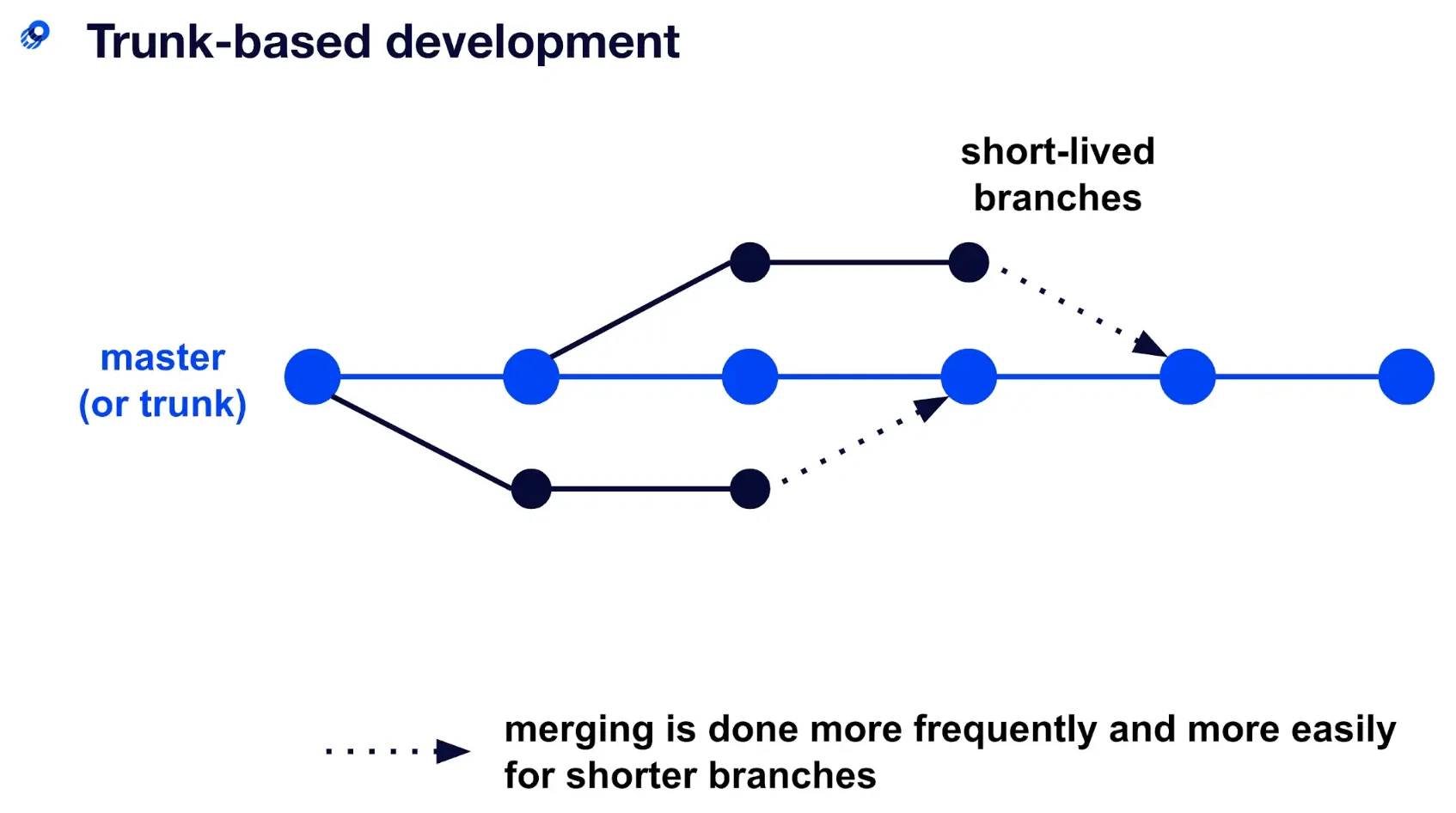
Trunk-based development is a source-code management strategy where all developers work on a single branch, usually called trunk or main. Any feature branches that are used are short-lived, and everyone integrates their changes back frequently to stay in sync with the main codebase.
It rests on three key principles: a single branch that everyone commits to, frequent commits that integrate changes regularly to minimize conflicts, and a green build policy that keeps the trunk in a releasable state at all times. Rather than living on long-lived branches, developers merge small changes often.
Trunk-based development vs GitFlow
GitFlow is a more structured Git workflow built around multiple types of branches, each with a specific purpose, where feature branches can be long-lived and are merged back only once a feature is complete. That structure can be helpful, but it often leads to complex merges and conflicts when features are large or run for a long time.
Trunk-based development takes the opposite stance, favouring smaller, more frequent merges into the main branch. Because the difference between the trunk and any in-progress work stays small, conflicts are rarer and merging is simpler. The core distinction between the two models is the lifespan of branches and how often changes are integrated.
The benefits of trunk-based development
The most immediate benefit is fewer merge conflicts. Because developers commit and merge frequently, the gap between the main codebase and any in-progress work stays small, which sharply reduces conflicts, especially in large teams where many people work in parallel. Keeping the trunk continuously releasable also aligns naturally with CI/CD, since the code is always integrated, tested, and ready to deploy.
Working on a shared branch has softer benefits too. It promotes collaboration and communication by giving everyone a shared understanding of the codebase, avoiding the silos that form around long-lived branches. It reduces code drift, since frequent merging keeps everything aligned, and it simplifies the process by removing the overhead of managing and rebasing many long-lived branches.
The challenges of trunk-based development
Trunk-based development is not free of trade-offs. Because everyone merges into the main branch frequently, it demands discipline and rigorous, frequent testing to ensure those changes never break the build and the trunk stays releasable.
It is also not ideal for every scenario. Complex projects with large features that take a long time to develop and cannot easily be broken into smaller, incremental changes can be hard to build directly on the main branch. For most teams practising Agile and CI/CD, though, the benefits outweigh these challenges.
Trunk-based development and unit testing
Because every commit can go straight to a releasable main branch, the quality of each commit matters enormously, and that is where unit testing becomes essential. A unit test targets the smallest testable part of an application, usually a single function or method, and verifies that it behaves as expected, ideally accompanying every change a developer makes.
In practice, unit tests preserve code quality by validating individual components, prevent regressions by catching unintended effects of frequent merges early, and facilitate continuous integration by giving constant feedback on the health of the codebase. They also enable fearless refactoring, acting as a safety net that flags any change in behaviour, and they support the iterative, fast-feedback rhythm that Agile encourages.
When to use trunk-based development
Trunk-based development is best for teams that aim for rapid, frequent delivery, and it is especially valuable for medium to large teams where keeping many people's changes in sync is otherwise hard. It shines in environments that prize speed, efficiency, and a pipeline with minimal blockers.
It fits CI/CD projects naturally, because keeping the main codebase always releasable is exactly what continuous deployment needs, and it aligns with Agile's emphasis on frequent, incremental delivery. Teams that switch to it from GitFlow often cut deployment time significantly by spending far less effort resolving merge conflicts.
How 8grams uses trunk-based development
At 8grams, we favour trunk-based development for teams practising CI/CD, pairing frequent commits and short-lived branches with automated testing so the main branch stays releasable. It keeps delivery fast, merges simple, and the whole team aligned around one codebase.
Key takeaways
- Trunk-based development has all developers work on a single main branch with frequent, small commits and only short-lived feature branches.
- Its principles are one shared branch, frequent integration, and a green-build policy that keeps the trunk always releasable.
- Compared with GitFlow's long-lived branches, it means fewer merge conflicts and simpler merging, which fits Agile and CI/CD.
- It requires discipline and rigorous unit testing, and is less suited to large features that cannot be broken into incremental changes.
References & further reading
Common questions.
What is trunk-based development?
Trunk-based development is a source-control strategy where all developers work on a single main branch, integrate small changes frequently, and keep the trunk in a releasable state. Any feature branches used are short-lived.
What are the key principles of trunk-based development?
A single branch that everyone commits to, frequent commits that integrate changes regularly to reduce conflicts, and a green-build policy that keeps the trunk releasable at all times.
What is the difference between trunk-based development and GitFlow?
GitFlow uses multiple long-lived branches merged only when a feature is complete, which can cause complex merges. Trunk-based development favours small, frequent merges into one main branch, which keeps conflicts rare and merging simple.
What are the benefits of trunk-based development?
It minimizes merge conflicts, keeps the codebase always releasable for CI/CD, promotes collaboration around a shared branch, reduces code drift, and simplifies the process by avoiding many long-lived branches.
What are the challenges of trunk-based development?
It requires discipline and rigorous, frequent testing so that frequent merges never break the build. It is also less suitable for large features that take a long time and cannot be broken into smaller, incremental changes.
Why is unit testing important in trunk-based development?
Because commits can go straight to a releasable main branch, unit tests preserve code quality, catch regressions early, provide continuous-integration feedback, and act as a safety net that enables confident refactoring.
Does trunk-based development use feature branches?
It can, but only short-lived ones. Instead of long-running feature branches, developers create branches that live for hours or days and merge back quickly, keeping the difference from the trunk small.
Is trunk-based development good for CI/CD?
Yes. Keeping the main branch continuously releasable is exactly what continuous integration and continuous deployment require, so trunk-based development and CI/CD reinforce each other.
How does trunk-based development support Agile?
Agile prioritizes frequent, incremental delivery, and trunk-based development supports that by having developers continually integrate small changes into a shippable main branch, keeping the team fast and adaptable.
What is code drift and how does trunk-based development reduce it?
Code drift is when a long-lived branch diverges significantly from the main codebase, making merges hard. Frequent integration in trunk-based development keeps branches close to the trunk, which prevents drift.
Related concepts.
Working on something like this?
Tell us about your project and we'll get back to you within one business day.
Talk to 8grams