
By Glend MaatitaUpdated
What is GitOps?
GitOps is a modern approach to infrastructure and application management that uses Git as the single source of truth for declarative configuration. This guide explains what GitOps is, its core principles and benefits, and how ArgoCD brings GitOps to Kubernetes.
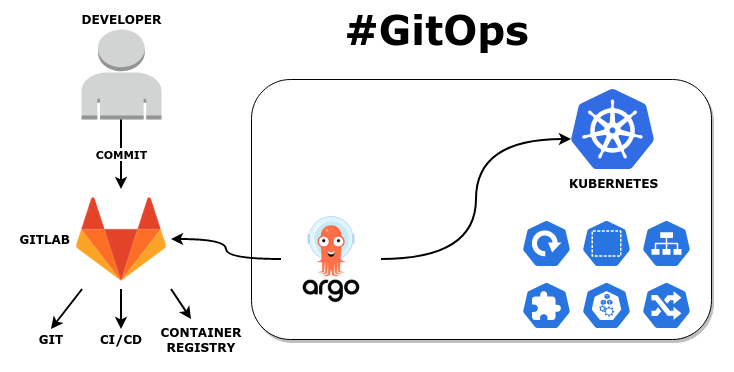
GitOps is a modern approach to infrastructure and application management that revolves around using Git as the single source of truth for declarative infrastructure and application code. It builds on the idea of Infrastructure as Code, solving some of the challenges IaC practitioners face while adding benefits of its own.
The approach has gained real traction alongside the rise of containers, Kubernetes, and the growing need for reliable, scalable infrastructure. Below, we explain what GitOps is, how it works, its core principles and benefits, and how ArgoCD puts GitOps into practice on Kubernetes.
What is GitOps?
GitOps is a way of managing infrastructure and applications in which Git holds the declarative definition of the entire system, and automated tooling keeps the running environment in sync with what Git says. Rather than making changes directly against a cluster or a server, you commit a change to a Git repository, and a GitOps tool applies it for you.
It extends Infrastructure as Code by adding a workflow around the code: everything is version-controlled, every change is reviewed and recorded, and the repository, not a person running commands, becomes the interface to your environment. That is what makes GitOps such a natural fit for cloud-native systems like Kubernetes.
The history of GitOps
The term GitOps was coined by Weaveworks in 2017, building on the established practices of continuous integration, continuous delivery, and continuous deployment (CI/CD). It took the version control, review, and automation that teams already used for application code and applied the same discipline to infrastructure and deployments.
How does GitOps work?
GitOps solves problems that often plague plain Infrastructure as Code, such as configuration scattered across machines, or several people changing and applying it without telling one another. It does this by following a few principles: consolidate all configuration code in one place, track it in a Git repository, and disallow direct changes to the running system. Instead of applying changes by hand, everyone commits and pushes them to Git.
From there, a GitOps tool continuously scans the repository for changes. When it detects an update, it automatically applies the new configuration to the environment. The goal is simple but powerful: the running infrastructure should always match the state defined in Git. That eliminates drift between what is deployed and what is described in code, and it leaves a detailed record of every change and who made it.
The four core principles of GitOps
GitOps rests on four principles that together make infrastructure management consistent, transparent, and auditable.
Declarative infrastructure and applications
The desired state of your infrastructure and applications is expressed in a declarative language, such as YAML for Kubernetes. You describe the outcome you want rather than the steps to get there, which keeps the codebase readable and maintainable and makes the system's state easy to reason about.
Version control
Git stores, tracks, and manages every change to the infrastructure and application code. That lets teams collaborate efficiently, keep a clear change history, and roll back easily when needed, while the audit trail of who changed what and when supports security and compliance.
Automated synchronization and convergence
An automated tool continuously monitors the Git repository and makes the running infrastructure converge to the state defined there. Any drift between the declared state and the actual state is detected and corrected automatically, which keeps the system consistent and stable.
Immutable infrastructure and observability
GitOps favours immutable infrastructure, where components are replaced rather than changed in place, which reduces drift, improves security, and simplifies troubleshooting. It also emphasizes observability, making it easy to see the state of the system and whether the running environment is in sync with Git.
Benefits of GitOps
Because Git sits at the centre, GitOps improves collaboration: team members work through version control, change tracking, and history, which brings coordination and transparency across teams. It also enhances security by leaning on Git's own features, such as access control and signed commits, so only authorized changes reach the infrastructure.
The declarative, automated model increases reliability by reducing human error and keeping environments consistent, and it enables faster recovery, since a clear history of changes makes it easy to roll back to a previous known-good state. Together these make GitOps an ideal fit for modern, cloud-native environments.
What is ArgoCD?
ArgoCD is an open-source, declarative, GitOps-based continuous delivery tool built specifically for Kubernetes. It automates the synchronization between the desired application state defined in a Git repository and the actual state running in a Kubernetes cluster, so deploying becomes a matter of committing to Git.
Its key features follow directly from the GitOps model. ArgoCD keeps all Kubernetes resource configurations declarative and version-controlled in Git, automatically detects and deploys changes as they are committed, and gives you real-time visibility into the health and status of applications in the cluster. It also makes rollbacks to a previous configuration easy, maintains a detailed history of changes, and offers fine-grained access control and multi-tenancy so multiple teams can manage their applications independently.
Git repository best practices for GitOps
In GitOps, your Git workflow is the core of every deployment, so how you structure your repositories matters. A handful of practices keep the process clean and secure.
Keep application code and configuration (YAML) in separate repositories, so a configuration change does not trigger an unnecessary application rebuild and the two can follow independent lifecycles. Separate environments such as test and production using directories rather than branches, which avoids the pain of merging environment-specific configuration. Favour trunk-based development for configuration repositories, with a single trunk and short-lived branches per environment that are merged back through a pull request. Finally, protect the trunk with branch protection rules and clear approval policies, so only reviewed changes reach your live environments.
How 8grams uses GitOps and ArgoCD
At 8grams, we run Kubernetes deployments the GitOps way, with ArgoCD keeping each cluster in sync with a Git repository that acts as the single source of truth. That gives our clients consistent environments, a full audit trail of every change, and fast, low-risk rollbacks, all from the same Git workflow their engineers already use.
Key takeaways
- GitOps uses Git as the single source of truth, with automated tooling keeping the running system in sync with the declared state.
- It builds on Infrastructure as Code and was coined by Weaveworks in 2017, extending CI/CD to infrastructure.
- Its four core principles are declarative configuration, version control, automated synchronization and convergence, and immutable infrastructure with observability.
- ArgoCD applies GitOps to Kubernetes, automatically syncing cluster state with a Git repository and enabling easy rollbacks and real-time visibility.
References & further reading
Common questions.
What is GitOps?
GitOps is an approach to managing infrastructure and applications where a Git repository holds the declarative definition of the whole system and automated tooling keeps the running environment in sync with it. You make changes by committing to Git rather than acting on the system directly.
When was GitOps introduced?
The term GitOps was coined by Weaveworks in 2017, building on continuous integration, continuous delivery, and continuous deployment (CI/CD) by applying the same version control and automation discipline to infrastructure.
How does GitOps work?
All configuration is consolidated and tracked in a Git repository, and direct changes to the running system are disallowed. A GitOps tool continuously scans the repository and automatically applies any new configuration, so the running infrastructure always matches the state defined in Git.
What are the four core principles of GitOps?
They are declarative infrastructure and applications, version control with Git, automated synchronization and convergence to the declared state, and immutable infrastructure paired with observability. Together they keep the system consistent, transparent, and auditable.
What are the benefits of GitOps?
GitOps improves collaboration through version control and history, enhances security with access control and signed commits, increases reliability by reducing human error, and enables faster recovery through easy rollbacks to a known-good state.
What is the difference between GitOps and Infrastructure as Code?
Infrastructure as Code defines infrastructure in machine-readable files. GitOps adds a workflow on top of that: it makes a Git repository the single source of truth and uses an automated tool to continuously sync the running system to the repo, correcting any drift automatically.
What is ArgoCD?
ArgoCD is an open-source, declarative, GitOps-based continuous delivery tool built for Kubernetes. It automatically synchronizes the desired application state defined in a Git repository with the actual state running in a Kubernetes cluster.
Is ArgoCD only for Kubernetes?
Yes. ArgoCD is designed specifically for Kubernetes and manages Kubernetes resources. It keeps their configurations version-controlled in Git and continuously reconciles the cluster to match.
What is the difference between ArgoCD and FluxCD?
Both are open-source GitOps continuous delivery tools that sync a Kubernetes cluster to a Git repository. ArgoCD is application-centric and ships with a rich web UI, while FluxCD is a lightweight, controller-based toolkit that favours a more composable, CLI-driven approach.
How should you structure Git repositories for GitOps?
Keep application code and configuration in separate repositories, separate environments by directories rather than branches, use trunk-based development for configuration, and protect the trunk with branch protection rules and clear approval policies.
Related concepts.
Working on something like this?
Tell us about your project and we'll get back to you within one business day.
Talk to 8grams