
By Glend MaatitaUpdated
What is Infrastructure as Code?
Infrastructure as Code (IaC) is an approach to managing and provisioning IT infrastructure through machine-readable definition files instead of manual configuration. It treats infrastructure like software, so it can be versioned, reviewed, and deployed reliably. Here's what it means and why you should care.
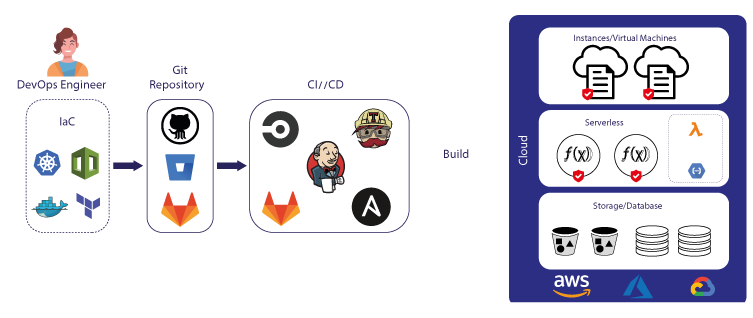
Infrastructure as Code (IaC) is an approach to managing and provisioning IT infrastructure through machine-readable definition files, rather than manual hardware configuration or point-and-click tools. It treats infrastructure the way you treat software, defined in code, stored in version control, and deployed through a repeatable process.
The payoff is infrastructure that is efficient, predictable, and reliable. Below, we explain what IaC is, why you should care about it, how pairing IaC with Git transforms auditability, and how the two most popular tools, Terraform and Ansible, fit together.
What is Infrastructure as Code (IaC)?
Infrastructure as Code is the practice of defining infrastructure, such as servers, networks, databases, and configuration, in machine-readable files instead of setting it up by hand. Those files are the single source of truth for what your environment should look like.
Because the definition lives in code, you can version it, review it, test it, and re-run it to recreate an identical environment on demand. IaC brings the discipline of software development to infrastructure management.
Why should you care about Infrastructure as Code?
Managing infrastructure by hand is slow, error-prone, and hard to reproduce, and IaC fixes each of those problems. Because every environment is built from the same definition, you get consistency and repeatability, which eliminates configuration drift and the “works on my machine” surprises that come with manual setup.
The practical gains follow from there. Provisioning a full environment becomes a single command rather than days of clicking, and that automation removes the manual mistakes that so often cause outages. It also means you can scale infrastructure up or down on demand as load changes, and recover quickly after a failure, since rebuilding the environment is just a matter of re-running the code.
How IaC and Git improve auditability
When Infrastructure as Code is combined with Git, the auditability of your infrastructure improves dramatically, that is, the ability to track and verify every change over time that security and compliance depend on. Every change becomes a commit that records who changed what, when, and why, giving you a complete version history you can trace to understand how the infrastructure evolved. Git's authentication and access controls add accountability, ensuring only authorized people can make changes and leaving a clear record of who is responsible for each one.
The workflow around Git reinforces this. Linking changes to specific commits gives you traceability, so an issue in production can be correlated with the exact change that caused it, and the pull request process brings code review and collaboration to infrastructure, vetting changes before they merge and preserving an audit trail of comments and approvals. If something does go wrong, you can roll back to a known-good version to recover quickly while keeping a full record of what happened. Plugging IaC into a CI/CD pipeline adds automated testing and validation before changes are deployed, and the IaC files themselves act as living documentation of the current state of the infrastructure and how it got there.
Infrastructure as Code tools: Terraform vs Ansible
There are many IaC tools, but two cover most needs and serve different purposes. Terraform focuses on provisioning and managing infrastructure resources, while Ansible focuses on configuration management and application deployment. Both are open-source and vendor-agnostic, and many teams use them together, with Terraform building the servers and Ansible configuring them.
Terraform
Terraform is an open-source tool from HashiCorp for provisioning infrastructure across multiple cloud providers and on-premises environments. It uses a declarative language, HashiCorp Configuration Language (HCL), so you describe the desired end state of your infrastructure rather than the steps to get there, which keeps configuration readable and maintainable.
Its real power comes from an extensive provider system: plugins that let Terraform manage resources on AWS, Azure, Google Cloud, VMware, OpenStack, and many other platforms through one consistent workflow and syntax. Terraform also promotes reusable modules to reduce duplication, keeps a state file that tracks the current infrastructure so it can calculate exactly what needs to change, and follows a two-step plan-and-apply workflow that lets you review changes before they are applied.
Ansible
Ansible is an open-source automation tool for configuration management, application deployment, and task automation. It uses simple, human-readable YAML playbooks to describe the desired state of a system and the tasks needed to reach it, and it runs on an agentless architecture, connecting over SSH or WinRM so there is nothing to install on the target machines.
Its tasks are idempotent, meaning a playbook produces the same result no matter how many times it runs, which keeps systems in the desired state safely. Ansible tracks the machines it manages through an inventory, which can be static or generated dynamically from a cloud provider, and it packages reusable configuration into roles that can be shared across playbooks and projects.
Infrastructure as Code and vendor-agnosticism
Both Terraform and Ansible are designed to work across multiple platforms, which prevents vendor lock-in. Terraform's provider system and consistent HCL syntax let you switch vendors or run a multi-cloud strategy without learning new tools, while Ansible's playbooks run anywhere you can reach over SSH. You choose the best solution for each need rather than being tied to one vendor.
How to get started with Infrastructure as Code
You can adopt IaC incrementally. Start by putting your infrastructure definitions in a Git repository so there is a single source of truth, then pick one tool and one environment to begin with, Terraform for provisioning or Ansible for configuration. Lean on the plan-and-apply (or dry-run) workflow so you review every change before it is applied, and add code review through pull requests so infrastructure changes are vetted like application code. Once that is in place, wire IaC into your CI/CD pipeline so changes are automatically tested and validated before they reach production.
How 8grams uses Infrastructure as Code
At 8grams, we build every environment with Infrastructure as Code, and we recommend two tools: Terraform for provisioning and Ansible for configuration management. Both are open-source and vendor-agnostic, so your infrastructure stays auditable, reproducible, and free of lock-in, on any cloud or your own hardware.
Key takeaways
- Infrastructure as Code (IaC) provisions and manages infrastructure from machine-readable files instead of manual configuration.
- It makes environments consistent, fast to build, less error-prone, scalable, and easy to recover.
- Pairing IaC with Git adds version history, accountability, traceability, review, rollback, and automated validation.
- Terraform handles provisioning (declarative HCL) and Ansible handles configuration (YAML playbooks), both open-source and vendor-agnostic.
Common questions.
What is Infrastructure as Code (IaC)?
Infrastructure as Code is the practice of managing and provisioning IT infrastructure through machine-readable definition files instead of manual configuration. It treats infrastructure like software, so environments can be versioned, reviewed, tested, and recreated reliably.
Why should you care about Infrastructure as Code?
Because it makes infrastructure consistent, fast to provision, and far less error-prone. You can rebuild an entire environment from code, scale on demand, and recover quickly from failures, none of which is practical with manual setup.
How does Infrastructure as Code improve auditability?
When IaC files live in Git, every change is a commit that records who changed what, when, and why. That gives you version history, accountability, traceability, code review, rollback, and automated validation, the foundation of a compliant audit trail.
What is the difference between declarative and imperative IaC?
Declarative IaC (like Terraform) describes the desired end state and lets the tool figure out the steps. Imperative approaches spell out each step to execute. Declarative tends to be more readable and easier to maintain.
Terraform vs Ansible, which should I use?
They solve different problems and are often used together. Terraform is best for provisioning infrastructure resources across clouds, while Ansible is best for configuration management and application deployment. Many teams use Terraform to build the servers and Ansible to configure them.
Is Terraform free and open-source?
Terraform is an open-source tool created by HashiCorp and is free to use. Managed offerings and enterprise features exist, but the core tool and its large ecosystem of providers are open-source.
What is idempotency in Infrastructure as Code?
Idempotency means running the same configuration multiple times produces the same result. Ansible tasks are designed to be idempotent, so applying a playbook repeatedly keeps the system in the desired state without unintended changes.
Does Infrastructure as Code work across multiple clouds?
Yes. Tools like Terraform and Ansible are vendor-agnostic and work across AWS, Azure, Google Cloud, and on-premises environments, which prevents lock-in and supports multi-cloud strategies with a consistent workflow.
What is a Terraform state file?
A state file is how Terraform tracks the current state of your infrastructure. It compares that state to your configuration to calculate exactly what needs to change during a plan-and-apply run.
Is Infrastructure as Code only for the cloud?
No. IaC works for public cloud, private cloud, and on-premises hardware. Terraform providers and Ansible's agentless model both support on-premises environments alongside cloud platforms.
Related concepts.
Working on something like this?
Tell us about your project and we'll get back to you within one business day.
Talk to 8grams