
By Glend MaatitaUpdated
What is DevSecOps?
DevSecOps integrates security into every stage of the DevOps lifecycle, from writing code to running it in production, so security becomes a shared, continuous responsibility rather than a final gate. This guide explains what DevSecOps is, why it matters, and how security fits into each stage of delivery.
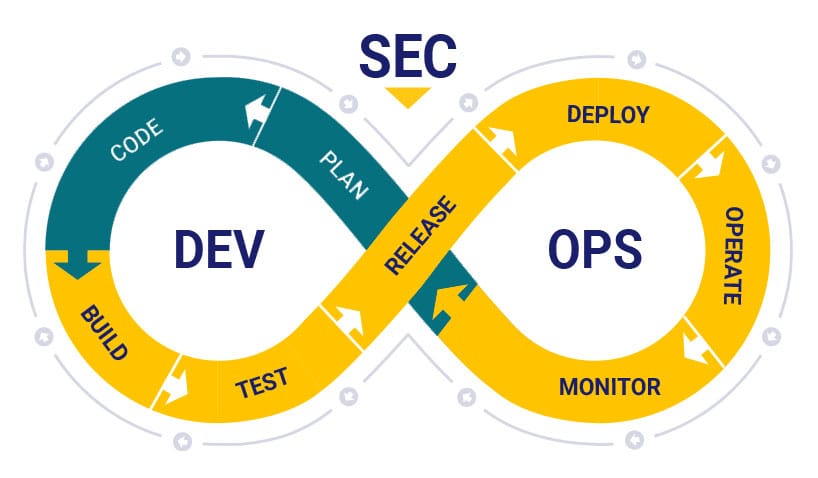
DevSecOps is the practice of weaving security into the DevOps lifecycle so that it is everyone's responsibility, at every stage, rather than a check performed at the very end. It builds on DevOps by adding the missing 'Sec': security controls that run continuously alongside development and operations.
Below, we explain what DevSecOps is, why treating security as a shared, continuous concern matters, and how it applies to each stage from writing code to monitoring it in production.
What is DevSecOps?
DevSecOps combines development, security, and operations into a single, continuous workflow. Instead of leaving security to a separate team at the end, it 'shifts security left', embedding automated checks and secure practices from the first line of code onward, so problems are found and fixed early.
The goal is to make secure software the default output of the pipeline. Security becomes a shared responsibility across the whole team and runs automatically, at the same speed as delivery, rather than slowing it down.
Why DevSecOps matters
When security is bolted on at the end, vulnerabilities are discovered late, when they are expensive and disruptive to fix, and they often ship anyway under deadline pressure. Building security into every stage catches issues when they are cheapest to resolve and keeps them out of production.
It also fits how modern software is built and released. With frequent, automated deployments, security has to be automated and continuous too, or it becomes the bottleneck that teams work around.
Security across the DevSecOps lifecycle
DevSecOps adds security controls to each stage of building, shipping, and running software.
Development
Security starts as code is written, with static application security testing (SAST) and linting tools like SonarQube catching vulnerabilities, bugs, and insecure patterns before they are ever merged.
Testing
Beyond functional tests, the pipeline runs automated security testing to probe the running application for weaknesses, complemented by targeted manual testing for issues automation cannot catch.
Packaging
Container images are hardened by using minimal base images like Alpine or Distroless, scanning them for known vulnerabilities with a tool like Trivy, storing them in a trusted registry, and signing them with Cosign so only verified images run.
Provisioning
Infrastructure is defined as code with Terraform or Pulumi and configured with Ansible, so environments are consistent, reviewable, and free of the manual misconfigurations that cause breaches.
Deployment
Deployments to Kubernetes are governed by policy engines like Kyverno, image signatures are verified, and a service mesh such as Istio or Consul secures and encrypts service-to-service communication.
Monitoring
In production, observability with OpenTelemetry, Prometheus, and Grafana, plus threat intelligence tools like OpenCTI, provide the visibility needed to detect and respond to incidents quickly.
How 8grams implements DevSecOps
At 8grams, we build DevSecOps into our clients' pipelines end to end, from static analysis and image scanning to signed artifacts, policy-enforced deployments, and production monitoring. Security runs automatically at every stage, so teams ship quickly without trading away safety.
Key takeaways
- DevSecOps integrates security into every stage of the DevOps lifecycle as a shared, continuous responsibility.
- It 'shifts security left', catching vulnerabilities early when they are cheapest to fix instead of at the end.
- Security applies across development, testing, packaging, provisioning, deployment, and monitoring, each with its own tools.
- Because releases are frequent and automated, security must be automated and continuous too.
Common questions.
What is DevSecOps?
DevSecOps is the practice of integrating security into every stage of the DevOps lifecycle, from writing code to running it in production, so security is a shared, continuous responsibility rather than a final gate.
What does 'shift left' mean in DevSecOps?
Shifting left means moving security earlier in the software lifecycle, embedding automated checks and secure practices from the first line of code, so vulnerabilities are found and fixed when they are cheapest, not at the end.
How is DevSecOps different from DevOps?
DevOps unites development and operations for fast, reliable delivery. DevSecOps adds security as a first-class, continuous part of that same workflow, so security keeps pace with delivery instead of slowing it down.
Why is DevSecOps important?
Because bolting security on at the end finds vulnerabilities late, when they are expensive and disruptive to fix and often ship anyway. Building security into every stage catches issues early and keeps them out of production.
What tools are used in DevSecOps?
Common tools include SonarQube for static analysis, Trivy for image scanning, Cosign for signing images, Terraform and Ansible for secure infrastructure, Kyverno for deployment policy, and Prometheus, Grafana, and OpenTelemetry for monitoring.
What is static application security testing (SAST)?
SAST analyzes source code for vulnerabilities and insecure patterns before it runs, during development. Tools like SonarQube flag issues early so they can be fixed before the code is merged or deployed.
How does DevSecOps secure container images?
By using minimal base images like Alpine or Distroless, scanning images for known vulnerabilities with tools like Trivy, storing them in a trusted registry, and signing them with Cosign so only verified images are allowed to run.
What role does infrastructure as code play in DevSecOps?
Infrastructure as code with tools like Terraform makes environments consistent, reviewable, and repeatable, which eliminates the manual misconfigurations that cause many breaches and lets security be checked automatically.
How do you secure deployments in DevSecOps?
Deployments are governed by policy engines like Kyverno, image signatures are verified before running, and a service mesh such as Istio or Consul encrypts and controls service-to-service communication.
How do you get started with DevSecOps?
Start by adding automated security checks to your existing pipeline, such as static analysis and image scanning, then progressively secure each stage from provisioning to deployment and monitoring, making security automatic rather than a manual final step.
Related concepts.
Working on something like this?
Tell us about your project and we'll get back to you within one business day.
Talk to 8grams