By Glend MaatitaUpdated
What is a Feature Flag?
A feature flag, also called a feature toggle, lets you turn features on and off at runtime without modifying or redeploying code. This guide explains what feature flags are, why teams use them to release safely, their benefits, and the tools available to manage them.
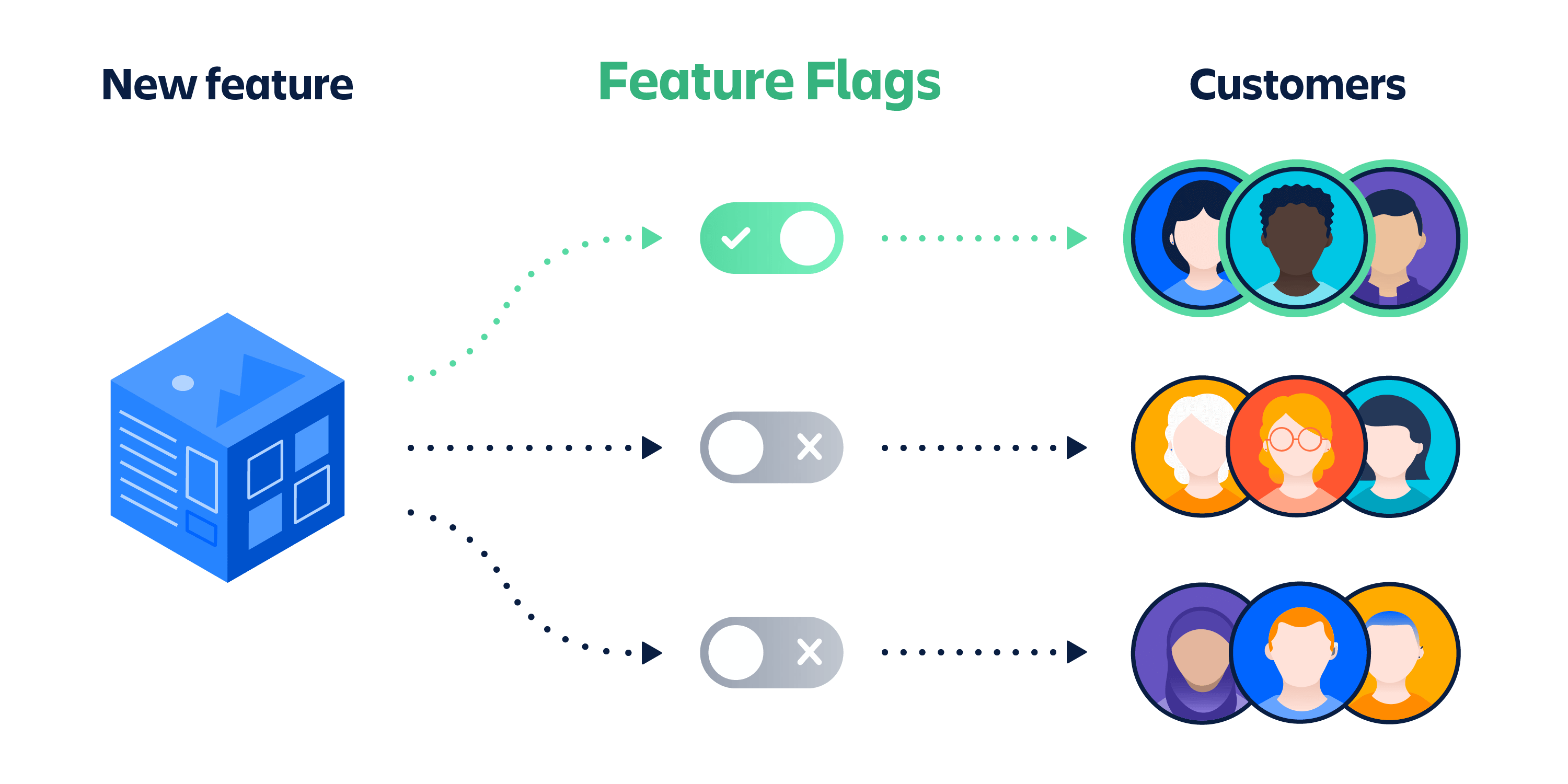
Among the many tools developers rely on, feature flags stand out for how much control and safety they add to releases. They let you decouple deploying code from releasing a feature, so shipping becomes far less risky.
Below, we explain what feature flags are, why teams use them, the benefits they bring, and the feature flag platforms available today.
What is a feature flag?
A feature flag, also known as a feature toggle, is a technique that turns certain features on and off at runtime, without modifying the code. The feature is already deployed; the flag simply decides whether it is active.
Imagine you are building an e-commerce website with a new recommendation engine that is ready to test but not ready for everyone. A feature flag lets you enable it just for a specific group, such as internal testers or a small set of users, without affecting anyone else.
Why use feature flags?
The core advantage of feature flags is that they let teams deploy code incrementally rather than all at once, which reduces the risk of any single release. Netflix famously uses a 'chaos monkey' flag that randomly shuts down services in production to test resilience, a vivid example of the control flags provide.
They also encourage experimentation. Because a new feature can run in production without being visible to all users, teams can run A/B tests and gradual rollouts to gather real feedback and iterate quickly. Flags enable dark launching too, where a feature is deployed to production but kept inactive, so you can test its impact on the live environment without disrupting the service, then switch it on for a small subset of users first.
The benefits of feature flags
Beyond reducing risk, feature flags allow user-specific customization, where features are tailored to particular user groups, which has become a cornerstone of personalized experiences. They simplify testing and quality assurance by isolating the impact of individual features, and they shorten the feedback loop between developers and users, since a feature can be adjusted quickly based on how people respond. LinkedIn, for instance, used feature flags to test and roll out a redesigned interface.
Flags also improve how teams work with code. A new feature can be merged into the main codebase early and simply kept inactive until it is ready, which avoids long-lived feature branches that are painful to merge. And they enable canary testing, where a feature is rolled out to a gradually increasing percentage of users so teams can monitor its impact and roll back instantly if something goes wrong, as Facebook did when launching its Reactions feature.
Feature flag tools and platforms
Several platforms offer robust feature flag management, and the right one depends on your needs. LaunchDarkly is a full-fledged feature management platform with many flag types, custom roles, flag dependencies, an intuitive dashboard, and SDKs for many languages, built to handle billions of evaluations a day, though it can be more than a small team needs. Split emphasizes data-driven decisions, with detailed flag analytics, integrations with data tools, and support for multivariate flags, at the cost of a more complex interface for beginners.
For teams that want full control, two open-source options stand out. Unleash is fully customizable but requires self-hosting and more setup and maintenance, while Flagsmith focuses on simplicity and offers both cloud-hosted and self-hosted deployments for flexibility. Before choosing, weigh cost, ease of use, integrations, support, and the specific capabilities you need: a small startup often wants something simple and cost-effective, while a large organization may need a more comprehensive system.
How 8grams uses feature flags
At 8grams, we use feature flags to help clients release new versions safely, decoupling deployment from release so features can be dark-launched, tested with real users through canary rollouts, and switched off instantly if an issue appears. The result is faster delivery with a built-in safety net.
Key takeaways
- A feature flag (feature toggle) turns features on and off at runtime without changing or redeploying code.
- Flags reduce deployment risk by decoupling deploy from release, enabling dark launching, A/B testing, and canary rollouts.
- They also allow user-specific customization, simplify QA, and let teams merge unfinished features early to avoid long-lived branches.
- Popular tools include LaunchDarkly and Split, plus the open-source Unleash and Flagsmith.
References & further reading
Common questions.
What is a feature flag?
A feature flag, also called a feature toggle, is a technique that turns a feature on or off at runtime without modifying the code. The feature is already deployed, and the flag decides whether it is active and for whom.
What is the difference between a feature flag and a feature toggle?
There is none; they are two names for the same technique. Both refer to switching a feature on or off at runtime without changing or redeploying the underlying code.
Why should you use feature flags?
Feature flags let you deploy code incrementally instead of all at once, which reduces release risk. They also enable testing in production, A/B tests, gradual rollouts, and instant rollback if a new feature causes problems.
What is dark launching?
Dark launching is deploying a new feature to production but keeping it inactive for general users. It lets teams test the feature's impact and functionality in the live environment without disrupting the service, before switching it on.
What is canary testing with feature flags?
Canary testing gradually rolls a feature out to an increasing percentage of users. Teams monitor its impact and performance as the audience grows and can roll back instantly if an issue appears, limiting the blast radius of any problem.
How do feature flags reduce deployment risk?
By separating deployment from release. Code can be deployed while the feature stays off, then enabled for a small group first. If something breaks, the feature is switched off immediately without redeploying or rolling back the whole release.
Do feature flags help with trunk-based development?
Yes. A feature can be merged into the main codebase early and kept inactive behind a flag until it is ready, which avoids long-lived feature branches that are difficult to merge later.
What are the best feature flag tools?
Common choices include LaunchDarkly, a full-featured management platform, and Split, which focuses on analytics and multivariate flags. Unleash and Flagsmith are popular open-source options for teams that want more control.
Are there open-source feature flag tools?
Yes. Unleash is a fully customizable open-source option that you self-host, and Flagsmith is an open-source tool focused on simplicity that offers both cloud-hosted and self-hosted deployments.
Can feature flags be used for A/B testing?
Yes. Because a flag can enable a feature for a specific subset of users, teams can run A/B tests in production, compare variations, gather real user feedback, and iterate quickly on the results.
Related concepts.
Working on something like this?
Tell us about your project and we'll get back to you within one business day.
Talk to 8grams