
By Glend MaatitaUpdated
What is Serverless?
Serverless computing lets you run code without provisioning or managing servers, while the cloud provider handles the infrastructure, scales automatically, and bills only for what you use. This guide explains what serverless is, how it works, its benefits and trade-offs, and how it compares to traditional client-server setups.
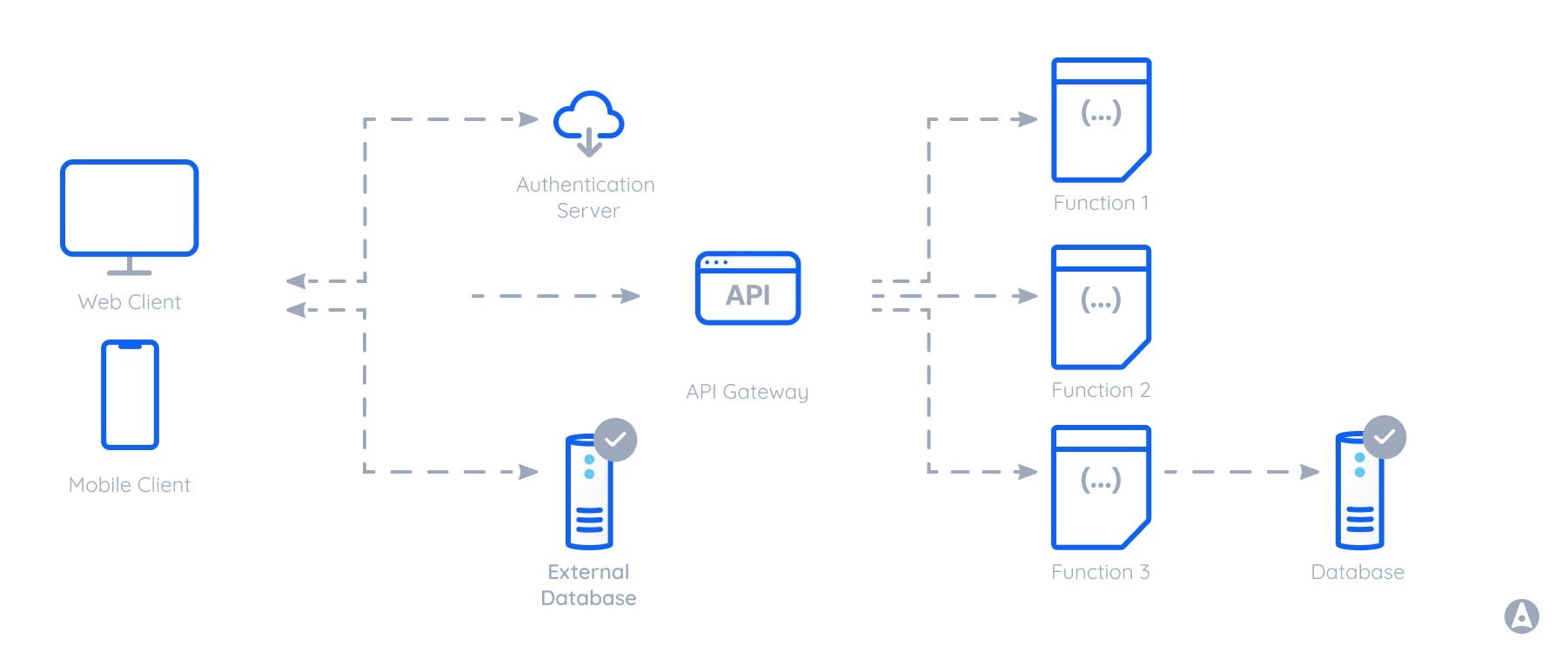
Serverless has become one of the most powerful ideas in cloud computing, letting teams ship features without worrying about the servers underneath. Despite the name, servers are still involved; you just never have to provision, scale, or maintain them yourself.
Below, we explain what serverless is, how it works, how it differs from a traditional client-server setup, and where it fits best.
What is serverless?
Serverless is a cloud model where you run application code without managing the underlying servers. The provider takes care of provisioning, scaling, patching, and capacity, so your team focuses only on the code and the features it delivers.
In its most common form, serverless means Functions as a Service (FaaS), where you deploy small, single-purpose functions that the platform runs in response to events, such as an HTTP request, a file upload, or a message on a queue.
How does serverless work?
With serverless, you deploy your code and the platform runs it on demand. When an event triggers a function, the provider spins up whatever capacity is needed, executes the code, and then scales back down, all automatically. You are billed only for the actual execution time and resources used, not for idle servers.
Because scaling is handled for you, a serverless function can go from zero to thousands of concurrent executions and back to zero without any manual intervention, which is what makes it so efficient for uneven or unpredictable workloads.
Serverless vs traditional client-server
The clearest difference is who manages the infrastructure. In a traditional client-server setup, you manage servers yourself, in-house or with a provider, and you scale them manually or with predefined policies, paying a fixed cost for the resources you provision. With serverless, the provider manages the infrastructure and scales it automatically based on demand, and you pay only for what you actually use.
That difference ripples through the rest of the workflow. Serverless deployments tend to be simpler and faster, require minimal maintenance from developers, and let the team focus on code and features rather than infrastructure, whereas traditional setups involve more complex deployment and ongoing maintenance and updates.
The benefits of serverless
The headline benefits are scalability and cost. Serverless scales automatically with demand, so you never over-provision or scramble during a traffic spike, and its pay-as-you-go billing means you only pay when your code actually runs, which can be dramatically cheaper for spiky workloads.
It also speeds up delivery. Deployment is simpler, maintenance is minimal, and because there are no servers to manage, developers can spend their time on features instead of infrastructure, which shortens time to market.
When to use serverless, and its trade-offs
Serverless is a strong fit for event-driven and variable workloads: APIs and webhooks, background jobs, scheduled tasks, data processing pipelines, and anything with unpredictable traffic. For steady, high-volume, or long-running workloads, a traditional or containerized setup can be more cost-effective.
The trade-offs are worth knowing. Functions that have been idle may experience a cold start delay on the first request, some designs can lead to vendor lock-in with a specific provider's platform, and long-running or heavily stateful workloads are harder to fit into the serverless model. Weigh these against the operational savings before committing.
Serverless platforms
The best-known serverless platforms are the cloud providers' function services: AWS Lambda, Google Cloud Functions and Cloud Run, and Azure Functions. These integrate tightly with the rest of each provider's ecosystem.
For teams that want serverless on their own terms, open-source options like OpenFaaS and Knative bring Functions as a Service to a Kubernetes cluster, giving you the serverless developer experience without being tied to a single public cloud.
How 8grams uses serverless
At 8grams, we use serverless where it fits best, for event-driven APIs, automation, and bursty workloads, and pair it with containers and Kubernetes for steady, long-running services. We also deploy open-source serverless platforms like OpenFaaS when a client wants the serverless model without vendor lock-in.
Key takeaways
- Serverless lets you run code without provisioning or managing servers; the provider handles infrastructure and scaling.
- It is usually delivered as Functions as a Service (FaaS), where event-triggered functions scale automatically and bill per use.
- Its main benefits are automatic scalability, pay-as-you-go cost, and faster, lower-maintenance deployment.
- Trade-offs include cold starts, potential vendor lock-in, and a poorer fit for long-running or heavily stateful workloads.
Common questions.
What is serverless computing?
Serverless is a cloud model where you run code without managing the underlying servers. The provider handles provisioning, scaling, and maintenance, and you are billed only for the resources your code actually uses.
Does serverless mean there are no servers?
No. Servers are still involved; you simply never provision, scale, or maintain them yourself. The cloud provider manages all of that, which is why the model is called serverless from the developer's point of view.
What is Functions as a Service (FaaS)?
FaaS is the most common form of serverless, where you deploy small, single-purpose functions that the platform runs in response to events such as an HTTP request or a file upload, scaling them automatically.
What is the difference between serverless and traditional client-server?
In a traditional setup you manage and scale servers yourself and pay a fixed cost. With serverless, the provider manages the infrastructure, scales automatically with demand, and charges only for actual usage, with simpler deployment and less maintenance.
What are the benefits of serverless?
Serverless scales automatically with demand, charges pay-as-you-go so you only pay when code runs, simplifies and speeds up deployment, and requires minimal maintenance, letting developers focus on features instead of infrastructure.
What is a cold start in serverless?
A cold start is the short delay that can occur when a function that has been idle is invoked, because the platform needs to initialize it before running. Frequently used functions stay warm and avoid this delay.
When should you use serverless?
Serverless fits event-driven and variable workloads well, such as APIs, webhooks, background jobs, scheduled tasks, and data processing. Steady, high-volume, or long-running workloads may be cheaper on traditional or containerized infrastructure.
What are the drawbacks of serverless?
The main trade-offs are cold-start latency, the risk of vendor lock-in to a specific provider's platform, and a poorer fit for long-running or heavily stateful workloads compared with containers or virtual machines.
What are examples of serverless platforms?
The best-known are AWS Lambda, Google Cloud Functions and Cloud Run, and Azure Functions. Open-source options like OpenFaaS and Knative bring serverless to a Kubernetes cluster without tying you to one public cloud.
Is serverless cheaper than traditional hosting?
It can be, especially for spiky or low-volume workloads, because you pay only when your code runs and never for idle capacity. For steady, high-throughput workloads, however, a provisioned or containerized setup may cost less.
Related concepts.
Working on something like this?
Tell us about your project and we'll get back to you within one business day.
Talk to 8grams